Pneumatic Dynamic Workholding
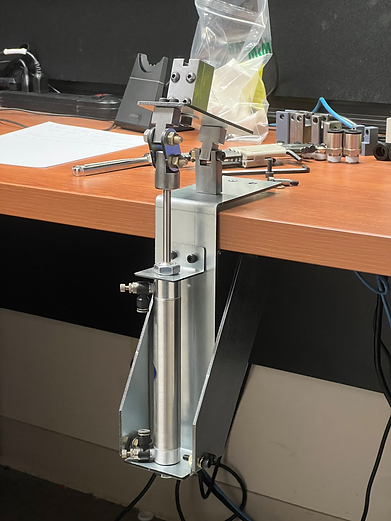
This fixture was created to alleviate ergonomic concerns for a sub-assembly operation. The jig changes the angle of the sub-assembly to allow easier visual and tool access to enable one-piece flow.
Skills:
Sheet Metal Design, Pneumatics & GD&T


Design Considerations & Decisions
This project was given to me under no pressure to give it a shot, as it had been passed down through several other previous interns. The criteria were very open-ended as this was part of an entirely new system being implemented, but were listed as follows:
- Must elevate subassembly to an operator-specified angle (~20 pounds)
- Must be able to be adjusted and operated swiftly
- Must limit operator stress/handling
After doing a proof of concept and trial for the overall mounting with a push toggle for the action, it was approved to make a prototype using a pneumatic cylinder. The assembly is comprised of five unique sheet metal parts lasered and bent to shape, with everything bolting together. The main bulk was made out of sheet metal, as 10-gauge metal is plenty stiff enough for the loads experienced and was able to be produced in-house without issue. The remaining parts were machined, but were simple and small enough to be made by the tool and die department
The pneumatic piston acts on a linkage allowing a range of motion of -30 to +50 degrees for the attached upper plate. Both the hinge and linkage are machined from steel and hinged on a 5/16th greased shoulder bolt held in with a nylock. This was done as an initial test that should last more than long enough to see if there are any potential issues. If I were to redo it, a press-fit bushing or sleeve bearing would be used in addition to the shoulder bolt to limit wear and further reduce the maintenance cycle.
To mount the fixture to the assembly table, it simply slips over the edge of the table, and two 3/8ths through bolts can go through the upper plate, through the table, and bolt to the lower plate with a nylock. This prevents any movement from the fixture itself.
Pneumatics were chosen for two reasons. The first being the load itself, as the item being fixtured onto the motion platform was roughly 15-20 pounds and cantilevered roughly a foot about the fixture itself. Pneumatics allowed for the stable lifting and descending without the possibility of slamming, as both sides were pressurized. Secondly, it enabled safe single-hand operation through the use of a 3-position valve for up, hold, and down.